



Reconstructive breast surgery
Breast reconstruction is not just a cosmetic procedure. It has a direct impact on the quality of life, body image and emotional wellbeing of the patient. For this reason, at HC Aesthetic, we approach the procedure from a comprehensive perspective, focusing on the medical aspects as well as the aesthetic and functional ones, with the aim of achieving a harmonious, natural and proportionate result in relation to the rest of the body.
At HC Aesthetic we offer you a safe, rigorous and completely personalised breast reconstruction after mastectomy or conservative surgery. Our goal is to restore the volume and shape of the breast and, when possible, to reconstruct the areola and the nipple, always in close coordination with your oncological team, respecting the time and criteria of the cancer treatment.
We offer a free initial consultation, where we carry out an initial assessment, answer your questions and clearly explain the most appropriate surgical options that best suit your case. We also offer video consultations for patients who live abroad, facilitating access to specialised care without the need for initial travel.
When is breast reconstruction performed?
Breast reconstruction can be performed at different times during treatment, and the choice depends on medical and oncological criteria as well as on the condition of the tissues and the patient’s preferences.
Immediate (performed at the time of mastectomy)
It has a better visual impact from the beginning and allows an earlier aesthetic recovery, provided that there is adequate skin perfusion and a fully compatible oncological plan.
Delayed
This is the most appropriate option when there is recent or planned radiotherapy, doubts about tissue perfusion, a history of infection or when the patient prefers to make a decision at their own pace.
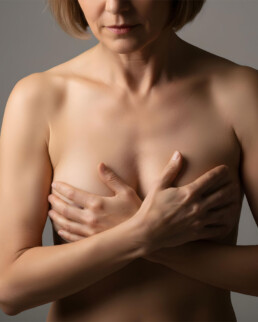
Breast reconstruction options
At HC Aesthetic, we offer a full range of breast reconstruction options, selected on an individual basis according to each patient’s clinical characteristics, the cancer treatment received, and their long-term aesthetic and functional goals.
Implant-based reconstruction can be performed in a single surgical stage by direct-to-implant placement, or in two stages, initially using a tissue expander that is subsequently replaced by the definitive implant.
The implant can be placed in:
-
- Prepectoral plane, when there is adequate skin coverage.
- Subpectoral or dual, plane when greater support is required in the upper pole.
In selected cases, biological or synthetic meshes are used to improve the stability and contour of the reconstructed area.
The implants we use are ergonomic, designed to offer a more natural drape and feel.
The main advantages of this technique are faster surgery and recovery and predictable results.
However, in patients who have received or will receive radiotherapy, the risk of capsular contracture is carefully assessed and the result is often optimised by lipofilling or by considering alternatives such as the latissimus dorsi flap.
This technique consists of transferring skin, fat and muscle from the dorsal region to the thorax, maintaining its original blood supply, to recreate the volume and shape of the breast.
It is especially useful in cases where there is a deficit of skin or tissue, or when the breast has undergone radiotherapy. In patients with small breasts, reconstruction can be performed using autologous tissue alone, while in other cases it is combined with an implant to achieve the desired volume, providing safer and higher-quality coverage.
Lipofilling is used to improve the cleavage, transitions and contours of the breast, as well as to optimise the quality of the skin, especially in previously irradiated tissues.
It is commonly used as a complement to implant or latissimus dorsi reconstructions, and, in selected cases, it can constitute the basis of a partial reconstruction.
At three to six months, 60-80% of the grafted fat is usually retained; the fat that attaches is permanent and its volume can vary with changes in body weight.
In patients who have retained the normal appearance of the breast after a lumpectomy, oncoplastic surgery makes it possible to treat the cancer and, at the same time, to avoid subsequent deformities.
By means of breast remodelling techniques, reduction or mastopexy patterns, lipofilling and symmetrisation procedures of the contralateral breast, it is possible to preserve the shape and harmony of the breast, improving both aesthetic results and quality of life.
When the reconstructive process allows it, the procedure is completed with the reconstruction of the nipple-areola complex.
The nipple can be recreated using local flaps, and the areola is defined using 3D micropigmentation, a medical tattoo that provides a natural and realistic result. This final phase contributes significantly to the sensation of a complete reconstructed breast and to the closure of the surgical process both at an aesthetic and emotional level.
Breast symmetrisation
Symmetrisation of the contralateral breast is a frequent and, in many cases, fundamental step in the breast reconstruction process. After a mastectomy and its subsequent reconstruction, differences in volume, shape or position between the two breasts are commonly found.
To correct these asymmetries, intervention on the healthy breast may be necessary using different surgical procedures, which can be carried out in the same surgical stage as the reconstruction or planned on a delayed basis.
Other types of breast reconstruction
Although we do not perform them at HC Marbella, it is important for you to know that there is another type of breast reconstruction surgery known as free flap breast reconstruction (autologous microsurgical breast reconstruction).
What is free flap breast reconstruction?
They are reconstructions using your own tissue (skin and fat, sometimes a minimum amount of muscle) transferred from another area (abdomen, thigh, buttock) to the breast by means of microsurgery (arteries and veins are connected to the thorax under a microscope). The result is a soft, natural breast that changes with your body weight and usually tolerates radiotherapy better than implants.
Our commitment
If the free flap breast reconstruction is the best option for your case, we will transparently inform you and we will manage the referral to an expert microsurgical team, supporting you throughout the process.
Who is it indicated for?
-
- Patients who prefer their own tissue and avoid implants.
- Patients with irradiated skin or with an indication for radiotherapy.
- Previous failures with implants (infection, capsular contracture, edge visibility.
- An adequate donor site is required and patients should be aware that this will result in a scar in that area.
Advantages and considerations
-
- Advantages: natural feel, good response to radiotherapy, no risk of capsular rupture.
- Considerations: longer surgeries (6-10 h), admission and monitoring of the flap, scar in the donor area, possible need for revision procedures (lipofilling, symmetrisation, NAC).

Information about breast reconstruction surgery
Breast reconstruction is a process that must be approached in a planned and coordinated manner, always integrated into the overall treatment plan of the patient.
Before the operation, close coordination with the oncology and breast surgery departments is essential, as reconstruction is part of a multidisciplinary approach. This joint planning makes it possible to decide the best time for surgery and the most appropriate technique depending on the oncological treatment received or planned.
One of the most important aspects is the complete cessation of smoking, which should be done at least four weeks before surgery and maintained for at least four weeks afterwards.
Similarly, it is advisable to have a stable weight at the time of surgery, as well as a good nutritional status and a well-maintained skin, as all of this favours a safer recovery and better results.
In many cases, reconstruction is planned as a staged process, which may include the initial placement of an expander, its subsequent replacement with a definitive implant, lipofilling sessions to improve the quality and volume of the tissues, and additional procedures on the nipple-areola complex or symmetrisation of the contralateral breast.
After surgery, there are several important considerations:
-
- Hospital stay: a hospital stay of between 24 and 48 hours is required, depending on the technique used.
- Drains: It is common practice to insert drains to prevent fluid accumulation. These are gradually removed during follow-up visits. A specific postoperative bra is also required. In cases where a latissimus dorsi flap has been used, a compression garment is also recommended for the back area.
- Pain: pain is managed using a scheduled analgesic regimen, provided the patient’s recovery permits.
- Return to daily routine: it is recommended to start walking from the first day. However, it is important to avoid significant physical exertion for a period of approximately four to six weeks.
- Physiotherapy: especially when the dorsal musculature has been operated on, helping to recover mobility and strength progressively.
- Scarring: when indicated, the use of topical silicone is initiated to improve scar quality, and strict photoprotection is advised for at least twelve months.
Possible complications include:
-
- Haematoma or seroma occurrence, infection, delayed healing or small areas of marginal skin necrosis.
- In reconstructions with implants, capsular contracture or displacement of the implant may occur. These risks are increased in patients who have received radiotherapy.
- Changes in sensation in the reconstructed breast or animation deformity when the implant is placed in subpectoral planes.
- In the case of the latissimus dorsi flap technique, possible complications include seroma formation in the back, a visible scar at the donor area, or temporary shoulder weakness, which usually improves over time with rehabilitation.
- Lymphoedema, mainly related to the previous axillary treatment rather than the reconstruction itself, but should nevertheless be taken into account in the overall follow-up of the patient.
Take the next step toward your best self.
Every transformation begins with a decision. Give yourself the care you deserve and discover how science, innovation, and personalised attention can enhance your well-being.
Frequently asked questions about breast reconstruction surgery
We know that breast reconstruction is a fundamental step towards regaining your wellbeing and confidence. In this section we answer the most intimate and frequently asked questions, supporting you with honesty on the way to this new stage in your life.
Not at all. The aim of immediate or delayed breast reconstruction is to restore physical integrity without compromising health. At HC Marbella, we work in coordination with the oncology team to synchronise surgical times, ensuring that the surgery does not interfere with chemotherapy or radiotherapy courses. The priority is always your healing, integrating aesthetics into the overall recovery process.
The choice depends on several clinical factors: the quality and elasticity of the skin after mastectomy, the blood perfusion of the tissues, the desired volume and whether adjuvant treatments are required.
The breast expander allows for gradual skin preparation, while direct-to-implant reconstruction is an excellent option in selected cases where skin coverage is optimal.
Radiotherapy may affect the elasticity of the tissues, but does not prevent reconstruction.
We plan each case to minimise complications: sometimes it is preferable to defer the final reconstruction, use lipofilling techniques (fat grafting) to improve the quality of the radiated skin, or resort to autologous tissue techniques (flaps) such as the latissimus dorsi flap, when this option provides the safest and most aesthetic result for you.
Yes, this is the final phase and contributes to a more natural-looking result. The reconstruction of the Nipple-Areola Complex (NAC) is usually performed using small local flaps to create the nipple structure and 3D medical micropigmentation to recreate the colour and shape of the areola, achieving a very satisfactory symmetry with respect to the contralateral breast.
Breast reconstruction is usually a staged process to ensure the best result: from the placement of the expander or implant, to refinement with lipofilling and symmetrisation of the healthy breast. At HC Aesthetic, we offer a comprehensive treatment plan from the beginning, so that you understand every single step of your journey to full recovery.
With the HC seal
Every detail reflects our commitment to excellence, safety and professionalism. At HC Aesthetic, our exclusive and personalised care transforms each treatment into a unique experience.