


Liposuction surgery
Liposuction is one of the most advanced and precise techniques in plastic surgery, specifically designed to remove localised fat deposits that persist despite maintaining a balanced diet and exercising regularly. Its primary aim is not weight reduction, but the sculpting of the body contour, restoring harmony and definition to problem areas that do not respond to conventional methods.
It is not a procedure intended to treat visceral or intra-abdominal fat, nor is it a solution for obesity. Therefore, the most satisfactory and dramatic results are achieved in patients who have a stable weight.
At HC Aesthetic, we understand that successful results depend on combining a refined surgical technique with the maintenance of healthy habits, ensuring that the new figure remains defined and balanced over time.
Who is liposuction recommended for?
Liposuction is indicated for patients whose weight is close to their target weight, who have maintained a stable weight for at least 3 to 6 months, have good skin elasticity and have realistic expectations regarding the results.
Localised fat deposits that do not respond to diet or exercise.
Gynaecomastia in men, in cases of excess fat or a mixed component.
As a complement to abdominoplasty or other post-bariatric surgeries.
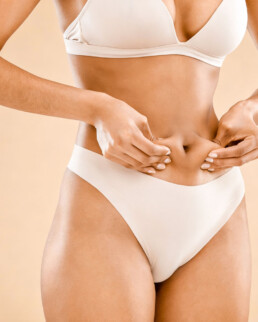
Uneven body contours in areas such as the abdomen, flanks, back, love handles, thighs, knees, arms, chin or ankles.
360° liposuction, indicated when seeking overall harmony of the abdominal and lumbar contours.
Lipoedema, in cases where surgical intervention is appropriate and following a specialist assessment.
Personalised liposuction
Each liposuction is approached in a completely personalised fashion, based on an individualised assessment of the patient.
- Complete medical history, usual medication and habits (tobacco, anticoagulants, etc.).
- Physical examination and marking in a standing position, defining the areas to be treated and skin retraction vectors.
- Medical photography and detailed explanation of the real benefits and limitations of the procedure.
- Recommendation of target weight and maintenance guidelines through diet and exercise.
- Identification of recipient areas in cases where fat transfer or lipofilling is indicated.
What areas are treated with liposuction?
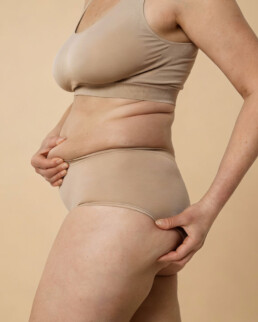
Liposuction enables the treatment of localised accumulations of fat in different areas of the body, provided that there is an appropriate indication and the goal is to improve the body contour in a balanced and natural way.
-
- Abdomen and flanks, to define the waist and improve the abdominal profile.
- Upper and lower back, including the dorsal folds and the bra area.
- Love handles and hips, very common in women.
- Inner and outer thighs, improving proportion and reducing friction between legs.
- Knees, especially on the inner side.
- Arms, in cases of localised fat accumulation.
- Double chin, to define the cervicofacial angle.
- Ankles, when there is localised fat accumulation.
Liposuction techniques and available technologies
At HC Aesthetic, the choice of liposuction technique is made on an individual basis, taking into account the patient’s anatomy, aesthetic goals and, above all, safety. We always prioritise a natural and harmonious result, avoiding artificial markings.
Tumescent liposuction
A tumescent solution (serum, anaesthetic and vasoconstrictor) is infiltrated and the fat is aspirated using fine cannulas.
It allows excellent volume control, thus favouring a fast and safe postoperative recovery.
PAL - MicroAire
The cannula performs a gentle oscillation that facilitates a more homogeneous extraction, with less trauma to the tissues.
Especially useful in fibrous areas (such as revision procedures, back or gynaecomastia) and for precise contouring.
VASER (ultrasound)
This technique selectively emulsifies the fat prior to aspiration. In selected cases, it can offer advantages such as greater contour definition, less bleeding and better skin retraction.
It is indicated for high-definition liposuction when the skin permits.
What to expect after liposuction
After liposuction, each patient undergoes an individual recovery process, in which medical follow-up, proper care and the adoption of healthy habits are essential for optimal and long-lasting results.
-
- Hospital stay: day case or 24 hours depending on volume and areas.
- Pain/swelling: maximum 48-72 hours. Progressive improvement.
- Bruising: usually lasting 2 to 3 weeks.
- Compression garment: continuous compression for 4 to 6 weeks (only treated areas; never compress grafts).
- Massage (lymphatic drainage/manual): we usually recommend around 10 sessions, starting at 48-72 hours or in accordance with progress.
- Return to work: 3 to 7 days following surgery in small areas, and 10 to 14 days in extensive liposuction.
- Physical activity: walking from the first day. Gentle cardio after 2-3 weeks. Strength/impact exercise after 4-6 weeks.
- Results: instantly visible, but definitive results are seen after 3-6 months (up to 6-12 months for all the normal fibrosis of the process to soften.
The number of adipocytes in the treated areas is permanently reduced, but the remaining adipocytes may increase in size if weight is gained. This is why we insist on:
-
- Maintaining a stable weight (ideally the target weight already achieved before surgery).
- Keeping a balanced diet and engaging in regular physical activity.
- Proper hydration and skin care to optimise retraction.
Scars in liposuction are minimal (2-4 mm), and are concealed in folds or underwear.
We recommend topical silicone, photoprotection and follow-up for optimal aesthetic evolution.
Although they are infrequent, the following may occur:
-
- Haematomas/seromas, infection or thrombosis.
- Irregularities or slight asymmetries in the body contour, transitory hyperpigmentation of the skin or changes in sensation in the treated area.
- Skin burns (very rare).
- In cases of fat transfer, partial fat resorption, cyst formation or fat necrosis may occur. In breast fat transfer, benign calcifications may appear; in such cases, we inform the patient to ensure correct interpretation in future radiological tests.
- Fat embolism in gluteal graft if fat enters the muscle (prevented with our subcutaneous technique and controls).
Limitations of liposuction
-
- It does not remove intra-abdominal/visceral fat.
- It does not correct severe excess skin: resection surgeries may be required (abdominoplasty, thigh/arm lift).
- Cellulite and stretch marks: may improve discreetly, but this is not their specific treatment.
- Abdominal ‘etching’: only in candidates with a low percentage of fat and good skin quality; we prioritise a natural result.
Fat transfer (body lipofilling)
We use the fat extracted by liposuction, purify it (decantation/filtration) and inject it in small micro-layers where volume increase or smooth transitions are desired.
-
- Buttocks and hips (‘hip dips’): for projection and shape.
- Breasts: for contour refinements or moderate augmentation.
- Face and chin, hands, calves.
- Scar depressions or irregularities.
Some of the grafted fat is naturally reabsorbed. As a reference, approximately 60-80% of the volume is retained after 3-6 months (this varies depending on the area, technique and habits). In large volume increases, a second session may be considered to achieve the desired volume.
Unlike aesthetic medicine products such as hyaluronic acid (resorbable), the patient’s own fat that ‘attaches’ is permanent: once neovascularised, it behaves like the rest of the body’s adipose tissue. This means that it will increase or decrease with changes in weight and age naturally with the other tissues. This is why we recommend maintaining a stable weight to preserve the result over time.
-
- Avoid pressure on the grafted area.
- No smoking, good hydration and nutrition.
- Compression should only be applied to donor areas; never compress the graft.
- Avoid local heat/cold and direct massage on the graft in the first few weeks.
We follow a specific safety protocol: exclusively subcutaneous injection, the use of appropriate cannulas, controlled trajectory and continuous movement technique. We avoid the intramuscular plane to minimise the risk of fat embolism.
Take the next step toward your best self.
Every transformation begins with a decision. Give yourself the care you deserve and discover how science, innovation, and personalised attention can enhance your well-being.
Frequently Asked Questions about Liposuction
We resolve your doubts about the procedure in a simple, straightforward way. Here you will find the answers to the most common questions our patients ask us before their consultation:
It is essential to understand that liposuction is not a treatment for obesity or a weight loss method. Its main objective is liposculpture: to reshape the body contour by eliminating localised fat deposits that do not resolve with diet or exercise. Although the silhouette improves significantly and the volume is reduced, weight loss is usually minimal.
Although the change is visible immediately, the final results are visible after 3 to 6 months, once the oedema (swelling) has almost completely subsided. However, the skin continues to retract and adapt to the new contour for up to 6 to 12 months after the operation.
The fat cells (adipocytes) removed during surgery do not regenerate. However, the cells that remain in the area can increase in size if there is a significant weight gain. Maintaining healthy lifestyle habits and a balanced diet is the key to permanent results.
When we perform fat grafting (lipofilling) in the buttocks or breasts, the body naturally reabsorbs part of the fat. Generally, between 60% and 80% of the transferred fat is permanently retained after the third or sixth month. In cases where a very significant volume increase is desired, a second session may be necessary.
In extensive liposculptures or combined procedures, drains are usually placed for 24 to 72 hours. Their function is to evacuate excess fluids, reduce swelling and lower the risk of seromas, speeding up the initial recovery process.
Yes, the use of a compression garment is essential for the first 4 to 6 weeks. This garment is vital to control swelling, reduce the appearance of bruising and, most importantly, help the skin to adhere correctly to the new contour, favouring optimal skin retraction.
High-Definition Liposuction (HD Lipo) is designed to tighten and define the musculature (such as the abdominals). It is recommended for selected patients with firm skin and a low percentage of body fat.
At HC Aesthetic, we always prioritise an athletic and natural outcome, avoiding artificial finishes that do not harmonise with the rest of the body.
With the HC seal
Every detail reflects our commitment to excellence, safety and professionalism. At HC Aesthetic, our exclusive and personalised care transforms each treatment into a unique experience.